
When you start comparing the budget between google ads vs facebook ads cost in 2026, you will notice that numbers alone aren’t enough; what’s more important is understanding what you are actually paying for and how this reflects on your conversion opportunities. In this article, we will build the comparison on the logic of running campaigns and how the two platforms behave with audience behavior and the ultimate goal.
Key Takeaways From Managing This Type of Campaign
From our experience managing PPC campaigns on Google Ads and Facebook Ads, the most common mistake we see is matching “cost-per-click” between the two platforms without linking it to your goal within the customer journey. Sometimes the goal is direct purchase, leading to quick performance improvement for Google, while at other times the goal is to build interest and then convert later, making Facebook appear more economical. We’ve learned that any respectable comparison must address three questions: What is the funnel stage? What type of conversion? And what is the quality of the landing page? Only then does the discussion about google ads vs facebook ads cost become practically applicable.
And because costs might sometimes seem close, we also focus on “user behavior after clicking”: Does the user complete the conversion journey? Does ad quality improve? Is there audience preconditioning before the ask? These details determine whether the amount you paid was an investment or a waste.
Why Do Advertising Costs Differ Between Google Ads and Facebook Ads? (google ads vs facebook ads cost)
Both systems operate on bidding, but the nature of the auction and how the platform interprets context differ. Thus, you might see higher CPC in Google Ads while seeing higher or lower CPM in Facebook Ads, and this can reflect on CPA in a completely different way.
1) How Costs Are Calculated in Google Ads
Google Ads often operates through cost-per-click (CPC), and your ads typically target users based on what they search for or what falls squarely within their interest on the Google Network. When the keywords are tied to clear buying intentions or urgent services, competition increases and the value of the click rises.
In our practical experience, we’ve noticed that Google Ads becomes more expensive when:
- Offers are tied to high-demand products or “necessity” services (like emergencies or strong local competition).
- You have strong competition from advertisers within the same area or using the same keywords.
- The landing page does not provide the user with a quick answer, weakening ad quality and requiring you to pay more to maintain visibility.
2) How Costs Are Calculated in Facebook Ads
In Facebook Ads, you may often see cost-per-thousand-impressions (CPM), with the option to use CPC depending on settings and goals. Importantly, Facebook focuses more on data, user behavior, and interests, rather than the “direct search” model employed in Google.
This can make entry costs lower, but it requires you to build your ad message stronger to convert impressions into clicks and then into conversions. Simply put: you might pay less, but if you don’t convince the user in the first few seconds, the price remains “cheaper” without yielding a return.
Why Isn’t Looking at Numbers Alone Enough?
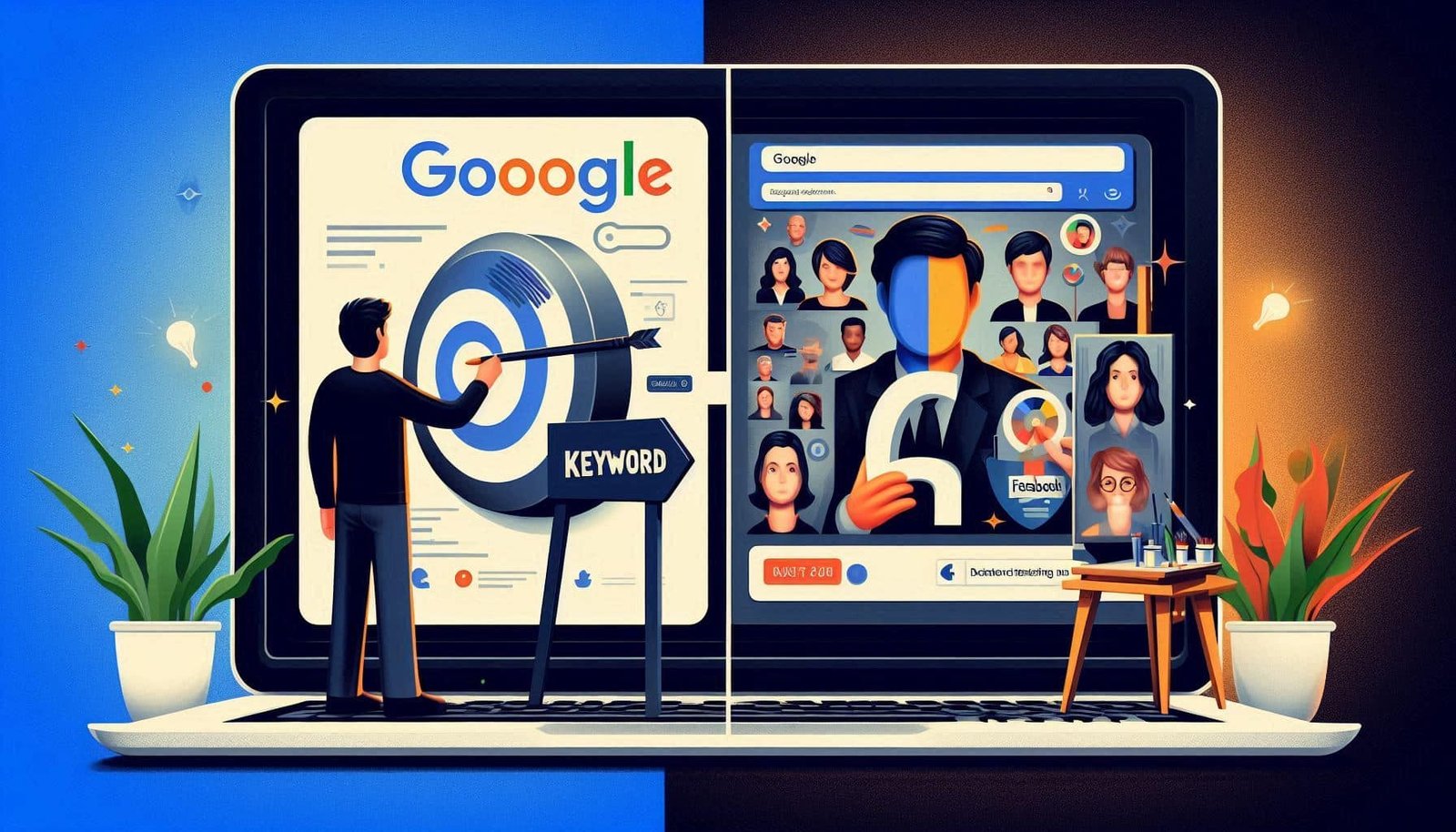
Because google ads vs facebook ads cost is not determined solely by CPC or CPM. Ask yourself: Are these clicks “ready to buy” or “ready to explore”? If the journey starts with wide awareness, then Facebook may make more sense. However, if the user is already in a strong comparison stage, Google will usually outperform.
Thus, we use a mix of metrics rather than a single cost:
- The cost to reach a clear interaction stage (like adding to cart or starting a form).
- The final conversion cost (CPA), not just click cost.
- The landing page completion rate and quality indicators (dwell time, depth of view, and relative bounce rate).
A Practical Look at Costs in 2025 and What’s Changing in 2026
On a general level, we find that Google Ads CPC is often higher in competitive sectors, while Facebook clicks may typically be cheaper. However, the real change we notice over time is the rising sensitivity of platforms to ad quality and landing page performance, not just “how much you pay”.
As guideline indicators (not a fixed rule for every market):
- Google Ads CPC: ranges from low to significantly higher in highly competitive sectors.
- Facebook Ads CPC: often lower in many categories, with significant variance depending on audience and creativity.
- Google Ads CPM: tends to be higher due to the nature of sites and context.
- Facebook Ads CPM: tends to be lower in many cases but can rise when targeting narrow segments or in strong ad competition.
This perspective helps you anticipate cost trends. However, to determine which is more profitable for you, you need a disciplined test and close monitoring of your conversions.
When Is Google Ads More Expensive… and When Does It Become More Efficient?
We often see that Google Ads seems more expensive when the demand windows are “instant”, meaning when the user searches for a specific solution or nearby service or a product ready to buy. This makes clicks closer to conversion even if their price is higher.
In practical application, Google Ads usually excels when you have:
- Products/Services with clear intent, which you can respond to quickly via the page or call.
- Measured conversion (forms, calls, purchases…), otherwise, you will lose CPA comparison.
- Campaign structure that reduces waste by targeting more precise keywords and ad groups.
However, if the landing page is slow or doesn’t match the ad, the bill will start to rise and the conversion rate will drop. Here, the issue is not just with the platform, but with the entire performance chain.
When Is Facebook Ads Cheaper… and Where Do The Risks Lie?
Facebook Ads often appear “cheaper” in costs per reach and click in many scenarios, especially in awareness and product discovery stages. However, the challenge is that the user may not be in a buying moment, thus you may need graduated messaging.
A consistent risk point we see is relying on a single campaign and one message. Instead, it is beneficial to build a sequence that increases the audience’s readiness for conversion.
We use a simplified model in our work: attract content first, then retarget, then a clear offer with incentives (price, trial, guarantee, or deadline). This reduces budget dispersion and increases the likelihood that clicks will convert to measurable results.
Important Alert: Do not compare the two platforms based solely on “CPC or CPM”. If you do not have accurate and unified conversion tracking between Google and Facebook, Facebook might seem cheaper on the surface while having a higher actual CPA, and vice versa. Make the final comparison standard the actual conversion cost based on your campaign goal.
How to Turn the Comparison into a Budget Decision? (From CPC to CPA)
When making a decision, consider conversion cost as this is closest to the final outcome. You might pay less per click on Facebook, but if you need additional steps to reach the purchase, the conversion cost may rise. Conversely, a Google click may be more expensive but brings the user closer to the buying decision.
As a practical principle we use: start by estimating the target CPA, then reverse the budget based on your conversion rate. If you have a low conversion rate on the landing page, then any platform will seem “expensive” because you’re paying without getting a return.
Operational Steps to Reduce Conversion Costs
- Set a clear goal: Direct purchase, form submission, or call… then evaluate it as an output.
- Test the ad before scaling: If it doesn’t achieve a good click rate and doesn’t start generating initial interactions, it’s not wise to increase the budget.
- Align the ad message with the page: same offer, nearly the same language, and conversion information in the same order of priorities.
- Monitor changes by audience: Warm Audience vs Cold Audience; the same ad may yield completely different results.
If you want a practical framework that helps you design broader campaigns and measure results, you can refer to the guide: google ads vs facebook ads complete guide 2 to organize the comparison according to your business type.
Professional Tip to Accelerate Learning and Reduce Waste
Professional Tip: Make your test short but rigorous: set a testing budget for each platform, and define two indicators to make the decision (e.g., initial interaction cost then conversion cost). After two to three weeks (depending on the volume of visits), decide whether to increase the budget or adjust the message or targeting. This approach prevents “inflating” a weak campaign because the click price was low at the beginning.
And from the aspect of targeting within Google Ads, understanding how audience observation adjustments can impact performance may benefit you, check: google ads audience observation benefits to enhance clarity on what you learn from audience data before fully transitioning to larger offers.
If your challenge is crafting offers and ads that attract without inflating costs, start from the principle of balancing the offer with customer expectations. We recommend reading: %d9%86%d8%b5%d9%8a%d8%ad%d8%a9 google ads %d8%b1%d9%82%d9%85 1 %d9%84%d8%a7 %d8%aa%d9%8f%d8%af%d9%90%d8%b1 ح%d9%85%d9%84%d8%a9 %d8%a5%d8%b9%d9%84%d8%a7%d9%86%d9%8a%d8%a9 %d8%ac%d9%8a as it helps you avoid a common mistake that drives up click costs without appropriate improvement in conversion.
Conclusion and Call to Action
The answer to google ads vs facebook ads cost is not “which is always cheaper,” but rather “which is more suitable for achieving a better CPA within your goal.” Google Ads tends to be higher in CPC when user intent is strong, while Facebook Ads often provide lower reach costs when building interest and moving the audience through incremental stages. Start today with a disciplined small experiment on your platform(s), and set the judgment standard by conversion cost rather than sheer price, then scale what works and fix what doesn’t.
Most Common FAQs
Can Facebook Ads Be Cheaper than Google Ads but Have Higher CPA?
Yes, and this happens often when Facebook clicks are cheaper because the user is in an exploratory stage, while a longer journey is needed to reach the final conversion. If the landing page does not convince quickly or if you do not have a message sequence to retarget interested parties, the apparent cost (CPC or CPM) might drop while CPA rises compared to Google Ads.
How Do I Determine the Best Platform for My Product: Google Ads or Facebook Ads?
Start with your goal: If the user is searching for a specific product/service or you have clear buying intent through search, Google Ads is often more suitable. If your product needs time to build interest or relies on visual content and trust-building, Facebook Ads will often be better in the upper stages. Then confirm your decision with a short test and measure CPA and actual conversions.
What’s the Best Metric for Comparing google ads vs facebook ads cost When Goals Differ?
When goals differ or funnel stages vary, do not compare using the same numbers alone. Use metrics that can be linked to the final outcome: conversion cost (CPA) for the same type of conversion, or cost to reach a meaningful step in the path (like starting a form/adding to cart). After that, judge which platform provides you with higher value for your budget.