
If you are wondering which option is better for balancing budget and achieving tangible results, understanding the real differences between google ads vs facebook ads is the right starting point—especially in markets that require rapid testing followed by smart scaling.
Our Practical Experience: Key Learnings from Managing Campaigns Across Both Platforms
During the management of multiple campaigns for different products and services, we noticed that the platform decision should not be based on “which platform is better” in general, but rather on one question: Is your audience ready to buy now or do you need to build awareness first? When a customer is actively searching, google ads vs facebook ads usually favors Google. And when the need is to build interest and deliver a strong visual message, we see Facebook providing greater value—especially when we link that to retargeting.
Most importantly: do not start by trying to achieve the maximum number of clicks. Start by defining the funnel stage each campaign is targeting, then make measurement clear (what counts as a conversion? and what is the value of that conversion?); because misinterpreting the data makes any platform seem “weaker” than it actually is.
Understanding the Differences that Really Change Performance in google ads vs facebook ads
1) User Intent vs Demand Generation
The most significant difference that directly impacts performance is the type of moment when the user encounters the ad:
- Google Ads attracts users at the moment they are searching for a specific solution—this often increases the likelihood of conversion.
- Facebook Ads provides you with an audience based on interests and behaviors, which often requires nurturing through messaging and then retargeting.
Therefore, when we compare google ads vs facebook ads in our work, we focus on the “type of signal” we are buying: is it a direct demand signal or an interest signal that needs preparation?
2) Actual Targeting: How to Reach the Customer on Each Platform
In Google Ads, we rely on the structure that links what the customer is searching for with what we offer in the ad. We utilize campaign settings to ensure that the message reaches people who display clear intent, then we use retargeting to remind them when they stray from the page.
In Facebook Ads, we typically work to create an ad pathway that starts from appropriate content—then direct attention toward an experience that leads to conversion. The strength of the platform here is not only in “direct demand”, but also in its ability to distribute messages rapidly across multiple segments.
3) Costs: Why Facebook Might Seem Cheaper But the Outcome Differs?
The cost in advertising is not just a CPC number. We monitor the cost impact on final conversions, because differences in user intent change the quality of visits.
In general, you may find that Facebook Ads offers a lower click cost, while Google Ads often sees a higher CPC against stronger intent. For this reason, we always advise reviewing the details of your accounts before making a final decision.
For a detailed comparison and how costs affect your decision, check the guide google ads vs facebook ads cost to find out what you should actually look at.
Also, when starting new campaigns, you may be confused by daily price fluctuations. The correct approach is to build a testing plan: allot a small budget, measure consistent metrics, and then scale what proves to achieve a reasonable acquisition cost.
4) Conversion Rates: When Does Google Have the Upper Hand? When Does Facebook Surprise You?
When the product/service falls within a space that the audience frequently searches for, you’ll typically notice that Google captures the “existing demand.” Conversely, Facebook excels when you need to deliver an attractive offer or story or social proof that stirs interest.
From practical experience, Facebook may also surprise you in conversion when:
- You have a strong primary ad that communicates value quickly.
- You use retargeting systematically rather than relying solely on direct visits.
- You target warm segments that have previously interacted with content or visited specific pages.
At this very stage, measurement becomes critical: does the conversion come from “the campaign that got the click” or from “the campaigns that followed it”?
Ad Types and Creativity: How Do Presentation Methods Differ?
Ad Formats in Google Ads
Google provides us with a variety of tools suitable for multiple stages, and we often see effectiveness in direct search scenarios such as:
- Search Ads.
- Display Ads.
- Shopping Ads.
- YouTube Ads when we want to link demand with visual content.
Ad Formats in Facebook Ads
On Facebook, we usually start from a visual attraction point because the user scrolls quickly. Hence, we focus on a design that stops scrolling and creates a reason to click, such as:
- Image Ads.
- Video Ads.
- Carousel Ads.
- Reels Ads.
- Instant Experience Ads.
Here, specifically, we see how creativity intersects with performance. When the message is clear and the hook is strong, Facebook becomes more capable of generating interest that later converts.
From a practical perspective, we prefer to test more than one creative angle (Feature/Benefit/Proof) instead of relying on just one format. This reduces “ad fatigue” and increases the chance of reaching a message that suits the segment.
How to Choose the Right Platform for Your Case? (A Quick but Realistic Decision Guide)
Choose Google Ads When…
- You can accurately identify keywords and search phrases related to what you offer.
- Your primary goal is to attract high-intent customers for quicker conversions.
- You have marketing support landing pages ready to receive visitors and clearly direct them to the next step.
- You work in a competitive market and care about directly reaching those who are searching.
Choose Facebook Ads When…
- Your product relies on visual appeal or storytelling or social proof (Reviews/Case snippets).
- Your goal is to build awareness or test messaging angles before scaling up.
- You have enough creative material (videos/designs/UGC) that raises quality rather than relying on text only.
- You can run retargeting across phases: view → engage → visit → convert.
Sometimes the best answer isn’t a single choice but distributing roles between the two platforms.
Integrating Both Platforms Together: The Path that Yields More Consistent Results
The best lesson we learned is that google ads vs facebook ads doesn’t have to be a battle of choice. We can build an integrated system that distributes the work between generating interest and capturing demand.
An example of a practical funnel path:
- Facebook Ads: starts by grabbing attention and sending the message to the right segments.
- Google Ads: captures people who are now more ready to search for the solution or your brand.
- Retargeting: gives you a final chance through appropriate messaging based on previous engagement.
This approach helps to increase the quality of conversion and reduce the “waste” that occurs when you spend a large budget on just one stage.
Important Alert: Do not base your budget on a single platform without a clear definition of conversion value. If you cannot link the financial outcome to conversions, you will be comparing uncomparable numbers (clicks instead of returns).
To enhance your understanding of how Google targeting works more accurately when dealing with different stages, you may find it beneficial to review google ads audience observation benefits and how observation settings can influence scaling decisions.
If you are taking the first step for campaigns with a limited budget, the idea of designing offers and ads in a disciplined manner helps you avoid budget exhaustion from random experiments. The guide Tip Google Ads No. 1 Do Not Run an Ad Campaign Yet provides a practical perspective to avoid beginner mistakes.
Professional Tip: Give each campaign a “specific goal” that does not overlap with others. A Google campaign for direct search, and a Facebook campaign for content/interest, then allocate retargeting for a later stage with different messages. This way, you will understand why one works and when the other needs support.
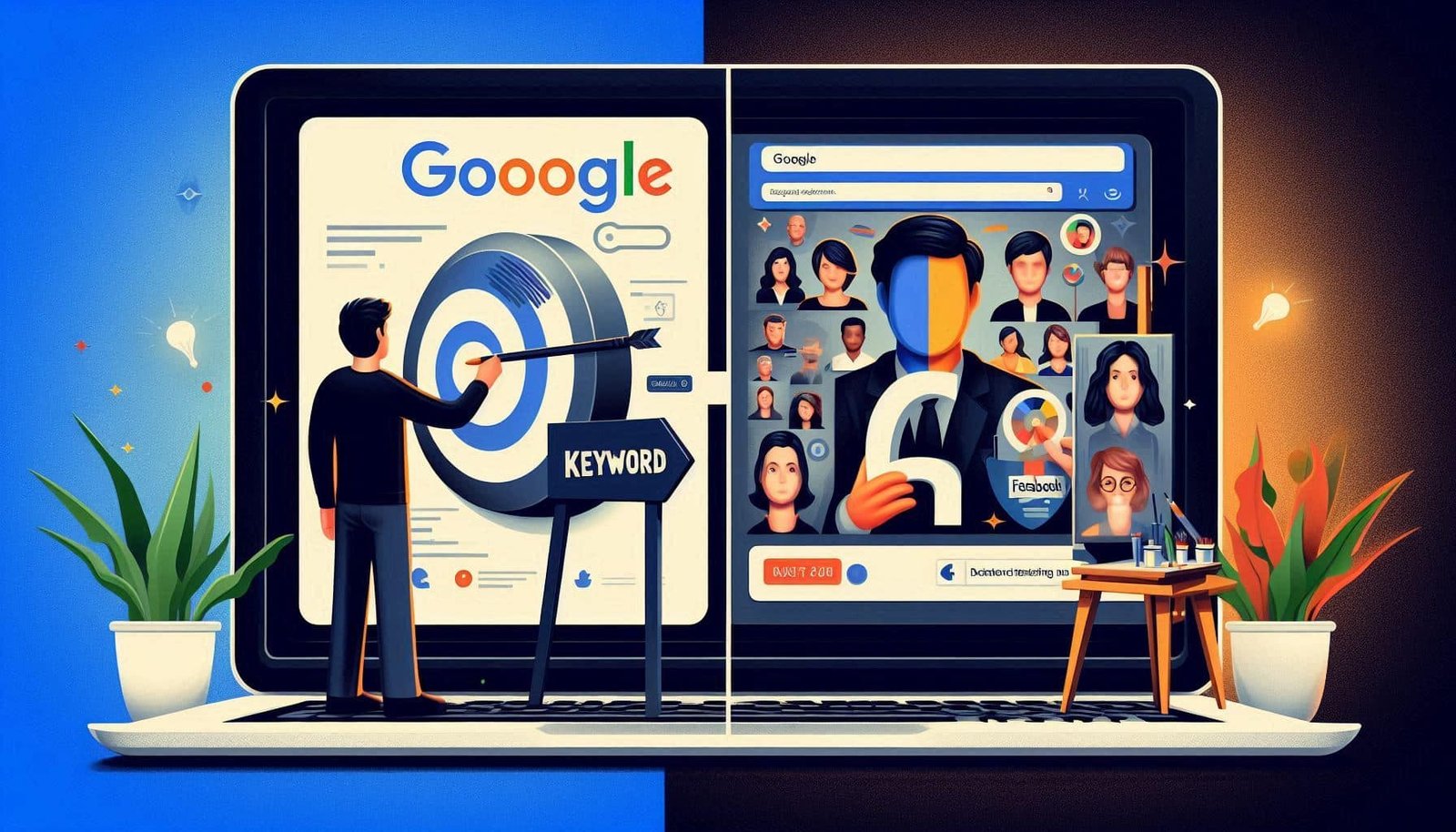
The Bottom Line: Your Decision in google ads vs facebook ads Should Be Based on Funnel Stage
Ultimately, the choice between google ads vs facebook ads depends on: your audience’s nature, are they looking for a solution now or do they need to create desire gradually, and whether you are ready to measure true conversion rather than just clicks. If you want to accelerate results immediately, you will often find Google a strong point, and if you need to build demand and interest quickly, Facebook offers significant value—but a thoughtful combination of both often gives you the best balance between CPA and ROAS.
Start with a small test, make the message appropriate for the stage, and then scale what proves to lead to measurable conversions.
Most Common FAQs
Should I start with Google Ads or Facebook Ads?
It depends on your project type and the targeted funnel stage. If your audience is already searching for your product/service (and there are clear search terms), starting with Google Ads usually provides quicker conversion signals. However, if you need to attract an audience that doesn’t know you yet or want content-based marketing, starting with Facebook Ads may be more suitable. Often, the best practical approach is to test both with a small budget but different objectives, then scale what achieves the best acquisition cost.
What is the most important difference in measurement between the two platforms to avoid misinterpretation?
The difference is not just in having measurement tools, but in the nature of the customer journey. Google may provide faster conversions because the user shows clear intent, while Facebook may play a role in the conversion journey through clicks or interactions that do not convert immediately. Therefore, it is crucial to evaluate performance based on “where did the conversion come from” and “is there a subsequent path” (like retargeting). Make the conversion definition clear and link it to an actual value if possible, so you don’t judge a platform solely on clicks or early indicators.
When is integrating both platforms better than relying on one?
Integrating google ads vs facebook ads is better when you notice that your awareness stage needs visual or messaging support (the strength of Facebook content), then you need to capture customers ready to buy when they start searching or interact directly (the strength of Google). Also, when the buying cycle is longer than to wait for an immediate conversion from a single campaign. In this case, dividing roles between the two platforms with retargeting directed to warm segments often raises stability and reduces the volatility in results.